Stress-Free City Parking: Park With Confidence Routine
Why city parking feels stressful (and why it doesn’t have to)
City parking compresses a lot of judgment into a few seconds. One block looks open, the next has a surprise street-cleaning window, and the car behind you suddenly decides you’re taking too long. The stress usually comes from uncertainty—not from the maneuver itself.
- Unclear rules and signage: Time limits, permit zones, street cleaning windows, and loading rules can change mid-block.
- Pressure from traffic: Honks and close following push drivers to commit before they’ve fully checked legality and space.
- Space judgment under uncertainty: Tight gaps, poor lighting, rain, and reflections make distances harder to read.
- Consequences stack up: Tickets, towing, curb rash, blocked driveways, and wrong-hour parking can turn a small mistake into a costly one.
- A repeatable decision flow reduces stress: scan → evaluate legality → assess space → align → finish → verify.
The “Park With Confidence” approach: simple steps guided by smart prompts
Instead of improvising every time, use a short routine you can repeat on any block. The goal is to create time, reduce missed details, and make each attempt feel familiar—even when the street isn’t.
- Start with a pre-park reset: Ease off the accelerator early, signal sooner than you think, and give yourself a few extra seconds to observe. Rushing is the biggest parking error multiplier.
- Use a consistent scan pattern: Signs first (legality), then curb paint/markings, then driveways/hydrants/corners, then the space size and traffic gaps.
- Commit only after two checks: (1) legal to park, (2) safe to maneuver without forcing other cars to brake hard.
- Rely on reference points, not guesswork: Mirror-to-curb alignment, rear wheel position, and a fixed turn-in point reduce “one-off” attempts.
- End with verification: Straighten wheels, confirm distance from curb, check for blocked access, and re-read the closest sign before leaving.
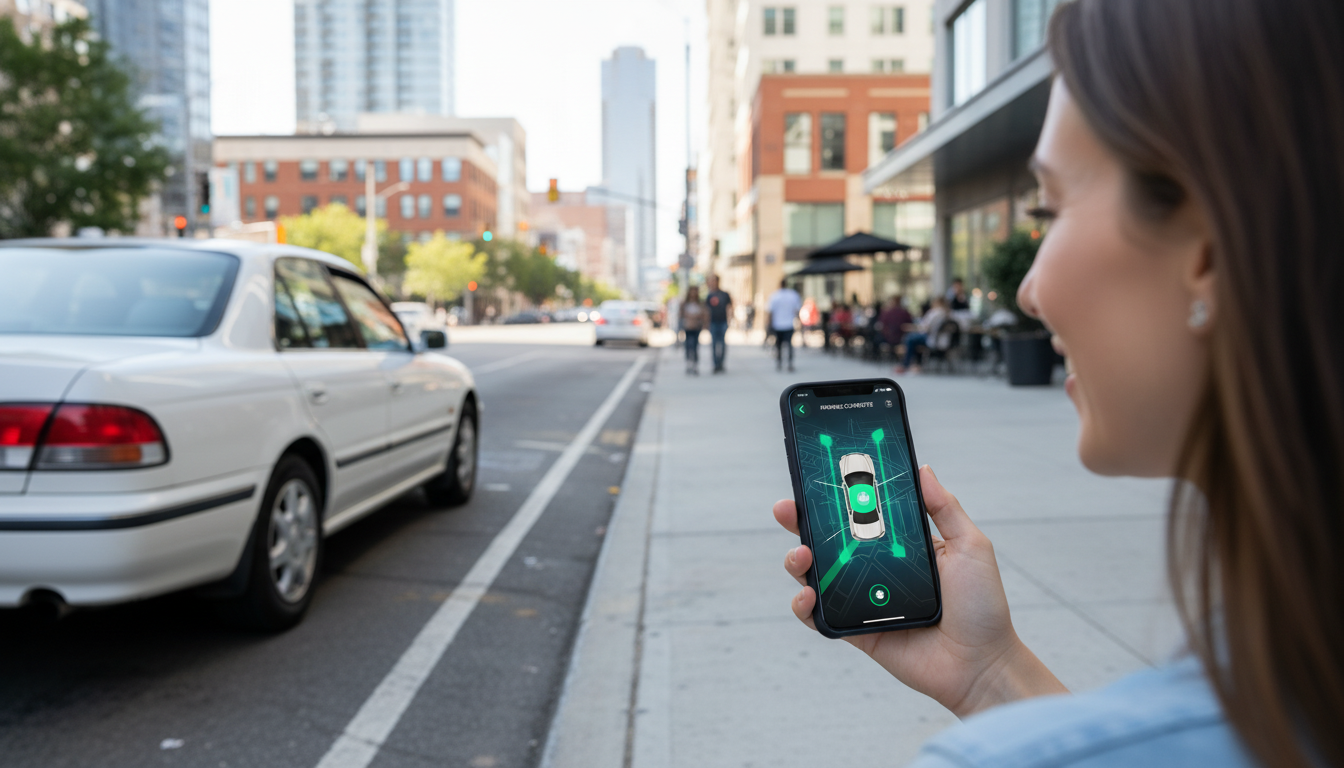
For a structured, step-by-step routine you can follow consistently, consider the digital guide: Park With Confidence Using Smart AI Guidance – Practical Digital Guide for Stress-Free City Parking, ai parking help and guidance Made Simple.
Practical AI-assisted guidance: what it can help with (and what it can’t)
“AI-style” parking guidance works best as decision support: it helps you remember what to check and what order to check it in, especially when your attention is split between signs, pedestrians, and traffic flow.
- Helpful for decision support: Step-by-step checklists, reminders about common restrictions, and structured routines to reduce missed details.
- Helpful for reducing mental load: A consistent scan prevents forgetting hydrants, corners, driveways, and timed regulations.
- Helpful for maneuver coaching: Breaking parallel parking into repeatable micro-steps and offering troubleshooting when your angle is off.
- Not a replacement for posted signs: Temporary restrictions (construction, events) still require direct confirmation.
- Not a substitute for safe driving: Avoid interacting with any app while the vehicle is moving; set guidance up only after you’re safely stopped. For safety context, see NHTSA – Distracted Driving.
Quick decision table: choosing the best parking option on a crowded block
| Option | Best when | Watch-outs | Fast check before leaving |
|---|---|---|---|
| Curbside parallel spot | You can align smoothly and traffic gaps are predictable | Hidden signage, tight clearances, driveways | Read nearest sign; confirm clearance from hydrants/corners; wheels straight |
| Angled curbside spot | Street design supports easy entry/exit | Limited visibility backing out; bike lanes | Confirm line/curb alignment; check for bike lane behind |
| Metered spot | You need a short stay and signage is clear | Max time limits; payment rules vary | Payment confirmed; time limit noted; receipt/app status saved |
| Garage or lot | You want predictability and less street pressure | Higher cost; height restrictions | Keep ticket/payment method; note level/section for return |
| Temporary pull-in area (loading/ride-share zones) | You’re stopping briefly and rules allow it | Strict enforcement; time windows | Re-check zone hours; don’t leave vehicle if prohibited |
Common city parking scenarios and simple fixes
Tight parallel spot
High-curb or low-curb edges
Night or rain glare
Hills
Busy downtown blocks
Avoid tickets and awkward surprises: the 60-second legality check
For broader planning context on how cities manage parking supply and rules, see Federal Highway Administration – Parking Management.
Building calm confidence (without rushing or freezing)
- Use a repeatable script: The same scan order and maneuver steps reduce uncertainty over time.
- Treat honks as background noise: Safety and legality come first; pulling out to reset is often faster than forcing a bad attempt.
- Set a personal “reset rule”: After one messy alignment, restart the setup rather than stacking corrections.
- Practice during low-traffic windows: Confidence grows fastest when the environment is forgiving.
- Reinforce the mindset: A simple confidence framework can help you stay steady under pressure. See Confidence, Not Ego – Checklist to Understand Confidence vs Ego Explained Simply | Daily Builders, Ego Traps, AI Tips & Quick Test.
For general driver safety guidance and reminders that support better choices in tight city environments, visit AAA – Driver Safety Information.
FAQ
Is AI guidance enough to park safely in a busy city?
AI-style guidance can support a structured routine, but it doesn’t replace reading posted signs, checking mirrors and blind spots, or yielding to pedestrians and cyclists. Set up any guidance only when safely stopped, and treat local rules and real-world conditions as the final authority.
How can parallel parking feel easier without special sensors?
Use consistent reference points (a repeatable turn-in point and mirror checks for curb distance), make small corrections, and reset early if the setup is off. Practicing in low-pressure settings builds the feel for spacing faster than forcing high-stress attempts.
What’s the fastest way to avoid a parking ticket?
Do a 60-second legality scan: read the nearest sign(s) in both directions, confirm zone and time limits, check hydrants/driveways/corners, and verify payment and max time before walking away.
















Leave a comment