Competence Builds Confidence: A 4-Week Practice Loop
Why competence makes confidence feel natural
Confidence feels steady when it rests on something repeatable: the ability to do the thing, on demand, under normal levels of pressure. When your actions consistently produce the outcomes you expect, hesitation drops because there’s less guessing and fewer “maybe I’ll mess it up” spirals.
Competence also creates a calmer baseline. You’re not relying on hype, praise, or a perfect mood to perform—you’re relying on a known process and a set of fundamentals you’ve already tested. That makes self-assessment more accurate: you know what you can handle, what you’re still learning, and what your next step should be.
Over time, progress looks less like a constant upward climb and more like tighter execution when things get messy: quicker recovery after a mistake, faster problem diagnosis, and clearer communication when it matters.
A simple model: competence → evidence → self-trust
If confidence has felt inconsistent, use a loop that makes it measurable.
- Competence: learn the fundamentals and the “must-not-fail” basics of a skill—the small set that unlocks most of the results.
- Evidence: collect proof through reps, feedback, and outcomes you can track (before/after, time saved, errors reduced, smoother delivery).
- Self-trust: use that evidence to take slightly bolder actions—apply for roles, volunteer to lead, speak up in meetings—then repeat the loop.
This approach helps separate healthy confidence from overconfidence because your belief is tied to observable performance, not wishful thinking. If you want the psychology behind why evidence matters, self-efficacy is a useful framework (see Britannica’s overview of self-efficacy).
Choose one confidence domain to train (not your whole life at once)
Trying to “be more confident” everywhere at once usually turns into vague effort and quick burnout. Instead, pick one domain where increased capability would immediately reduce stress: communication, fitness, public speaking, leadership, budgeting, or a core job skill.
- Define a clear “better than last month” outcome (example: deliver one 5-minute update weekly without rushing).
- List the three sub-skills that drive results (example for speaking: structure, voice pace, handling questions).
- Set a practice cadence that fits real life: 15–30 minutes, 3–5 times per week is often enough when focused.
Small scope isn’t small ambition. It’s how you build momentum without turning your schedule into a second job.
Deliberate practice that actually builds competence
Competence grows fastest when practice is slightly uncomfortable and extremely specific. The goal isn’t to grind for hours; it’s to train the exact parts that cause hesitation.
- Train at the edge of ability: choose tasks that are slightly difficult with a high chance of small mistakes.
- Shrink the task: isolate the weakest link (practice openings and transitions before practicing entire talks).
- Use immediate feedback: record yourself, use checklists, compare against strong examples, or ask for one specific critique.
- Repeat short sets: 5–10 focused reps beat one long, unfocused session.
- End with a “next time” note: write one adjustment to test in the next session.
Competence-to-confidence practice plan (4-week starter)
| Week | Focus | Practice (15–30 min sessions) | Evidence to log |
|---|---|---|---|
| 1 | Foundations | Learn the basics + do 3–5 small reps | Baseline score (time, accuracy, comfort 1–10) |
| 2 | Consistency | Same reps + add one constraint (speed, clarity, form) | Error count, completion rate, repeatability |
| 3 | Pressure | Simulate real conditions (timer, audience, distractions) | Performance under stress, recovery time after mistakes |
| 4 | Application | Use the skill in a real situation 1–3 times | Outcome metrics + a short reflection on what worked |
Turn progress into durable confidence (without hype)
Once you’re practicing, the next challenge is making sure your brain actually “counts” the progress. Durable confidence comes from noticing and recording evidence.
Resilience supports this process—especially when a skill requires repeated exposure to discomfort. The American Psychological Association’s guidance on building resilience pairs well with competence-first training because both focus on recoverability, not perfection.
Tools that help the process feel easier to follow
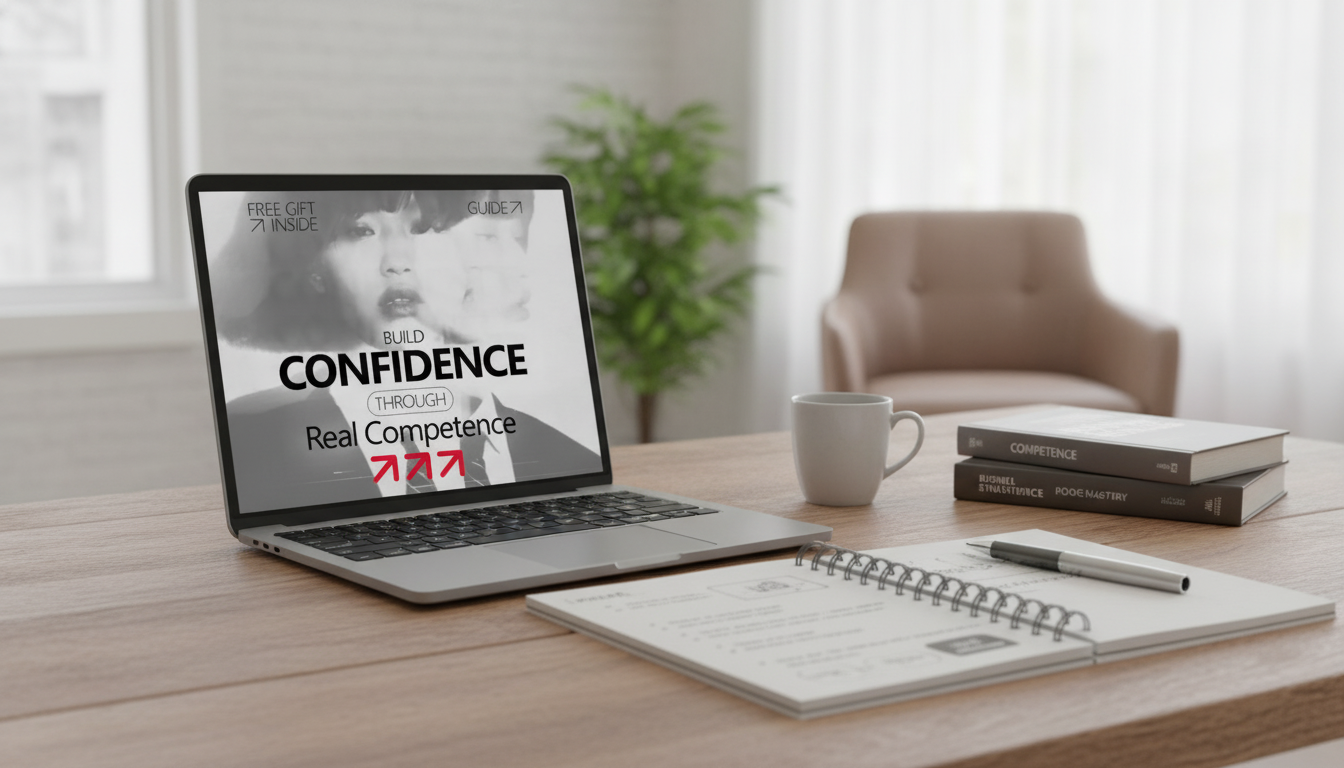
A structured guide can reduce overwhelm by turning skill-building into a repeatable routine: choose a domain, practice deliberately, track evidence, and apply it in real situations. For a step-by-step workbook-style framework, Build Confidence Through Real Competence (digital download) is designed to keep the loop simple and actionable.
Consistency often improves when sessions are scheduled like any other commitment. A planner-based approach can make it easier to protect 15–30 minute practice blocks and run weekly reviews; AI Tools to Organize Your Life Guide (daily planner companion) can support the scheduling and tracking side so the training doesn’t get lost during busy weeks.
If your confidence domain is money-related—like budgeting conversations, savings consistency, or reducing financial stress—structured checklists can help you create quick wins and evidence. “Save Like a Pro!” – The Ultimate Monthly Savings Checklist can be used as a simple way to log progress and reduce decision fatigue month to month.
Common traps that block confidence even when skills are improving
FAQ
How long does it take for competence to translate into confidence?
With consistent practice (15–30 minutes, 3–5 times per week), many people notice a real shift in 2–6 weeks. Confidence follows evidence, so log measurable improvements and include at least a few real-world reps to make the progress feel “real.”
What if confidence still feels low even after improving skills?
Confidence can lag behind skill when perfectionism is high or when progress isn’t being tracked. Add stress-simulation practice, get targeted feedback, and collect proof (metrics, recordings, and specific comments) so your brain has clear evidence to trust.
What’s the fastest way to build confidence for work presentations?
Narrow to sub-skills (structure, opening, pacing, Q&A), then do short deliberate reps with recording and time pressure. Pair that with small real-world exposures (one update in a meeting, one question answered) to convert practice into usable confidence.
















Leave a comment