Wear What You Love: Real Confidence Through Style

Wear What You Love: A Style-and-Mindset Path to Real Confidence
Confidence tends to rise when clothes feel like an honest extension of personality—not a costume built to meet someone else’s expectations. Wearing what you love can shift posture, reduce second-guessing, and make decisions easier because the signal is clear: this is you. The guide below breaks down why it works, how to build a wearable wardrobe around it, and small practices that make confidence show up consistently.
Why “what you love” changes how you carry yourself
When your outfit matches your inner sense of self, your brain spends less energy negotiating and more energy living your day. That “quiet certainty” shows up in subtle ways—steadier eye contact, calmer movements, and fewer mid-day outfit regrets.
- Authenticity reduces mental friction: fewer “Does this look right?” loops means more presence.
- Comfort and fit support body language: ease of movement often improves posture and openness.
- Personal meaning creates emotional armor: sentimental pieces or signature colors can feel grounding.
- Consistency builds trust with yourself: keeping style promises strengthens self-respect over time.
Researchers have explored how clothing can influence psychological experience and performance—sometimes called “enclothed cognition.” A helpful starting point is this systematic review on the psychological effects of clothing: Enclothed cognition: systematic review of psychological effects of clothing.
Confidence vs. approval: a simple mindset shift
Approval is a moving target; confidence is a decision. When those two get tangled, outfits become a daily referendum on your worth—especially in rooms where you don’t know the “rules.” A steadier approach is to treat confidence as internal permission and feedback as optional data.
- Confidence is internal permission; approval is external permission—mixing them creates chronic doubt.
- Swap the pre-exit question: replace “Will they like this?” with “Do I feel like myself in this?”
- Treat compliments as information, not a scoreboard: useful feedback without letting it steer identity.
- Set one non-negotiable style value: comfort, color, modesty, edge, or minimalism—use it as your anchor.
That internal permission is closely related to self-efficacy—the belief that you can act effectively in a situation. For a quick, clear definition: APA Dictionary of Psychology: self-efficacy.
Find your “love list”: the fastest way to define your style
If your closet feels random, don’t start by buying more. Start by noticing what already works. A “love list” is a small collection of outfits that make you feel like you can breathe, move, and show up fully.
- Collect 10 outfits you genuinely love (screenshots, saved posts, old photos).
- Identify repeating elements: silhouettes, fabrics, color families, accessories, vibe (sporty, romantic, sharp, artsy).
- Name your top 3 style cues (example: “structured + neutral + clean lines”).
- Choose 1–2 “signature” items: a jacket shape, a shoe style, a jewelry stack, or a color that shows up often.
Quick style cue worksheet
| Prompt | Examples to look for | Write yours |
|---|---|---|
| Silhouette | wide-leg, fitted, oversized, tailored | |
| Textures/Fabrics | denim, knit, linen, leather, satin | |
| Colors | earth tones, monochrome, jewel tones, pastels | |
| Details | zips, gold hardware, prints, collars, pleats | |
| Mood words | calm, bold, playful, elegant, edgy |
Build confidence outfits with a 3-layer approach
Confidence outfits aren’t always “fancy.” They’re reliable. A three-layer formula makes it easier to repeat what works while keeping the look personal.
- Base layer: the piece that feels best on the body (well-fitting tee, bodysuit, soft knit, breathable tank).
- Structure layer: adds polish and posture (blazer, denim jacket, overshirt, cardigan with shape).
- Personality layer: a “this is me” detail (statement earrings, sneaker choice, scarf, belt, standout bag).
- Low-energy formula: keep one ready-to-go outfit pattern to reduce decision fatigue.
A practical personality layer that works across seasons is a clean, recognizable bag—easy to reach for, instantly intentional. The Calvin Klein Black Print Backpack with Zip is a simple way to add “finished” energy without overthinking accessories.
The confidence closet audit (keep, tailor, remix, release)
Instead of a dramatic closet purge, run a calm four-part audit. The goal isn’t minimalism; it’s alignment—so getting dressed feels supportive rather than adversarial.
Wearing what you like in real life: work, weekends, events
Confidence outfit swaps by setting
| Setting | Common default | Wear-what-you-love upgrade |
|---|---|---|
| Work | plain top + rushed pants | structured layer + signature accessory |
| Weekend | old hoodie + random jeans | comfortable base + clean sneaker + standout bag |
| Dinner/Event | new trend piece you’re unsure about | trusted silhouette in richer fabric + intentional color |
| Travel | uncoordinated comfort | matching set or consistent palette + one personality layer |
Micro-practices that make confidence stick
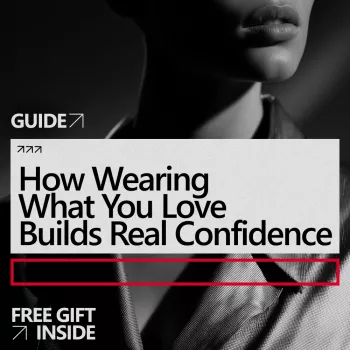
If you want a structured companion to keep the momentum going, How Wearing What You Love Builds Real Confidence | Style & Mindset Guide for a Confidence Boost from Wearing What You Like can help turn these ideas into a repeatable routine.
A practical guide to turning style into self-trust
FAQ
What if wearing what I love draws attention and makes me nervous?
Ease in with one “loved” element at a time—like a signature color, jewelry, or a bag—paired with familiar silhouettes. Start in settings where you already feel relatively safe, and prioritize comfort and fit so your body feels grounded while you adjust.
How do I know whether an outfit is “me” or just a trend?
Check it against your love list cues: if it matches your repeating silhouettes, colors, and details—and you can wear it without constant adjusting—it’s likely “you.” Trends work best when they plug into what you already love instead of replacing it.
Can confidence from clothing last, or is it temporary?
Clothing can create immediate ease, but lasting confidence comes from self-trust habits: clear boundaries, repeatable outfit formulas, and choosing comfort and fit over chasing approval. The more often you follow through on what feels right, the more stable that confidence becomes.










Leave a comment